

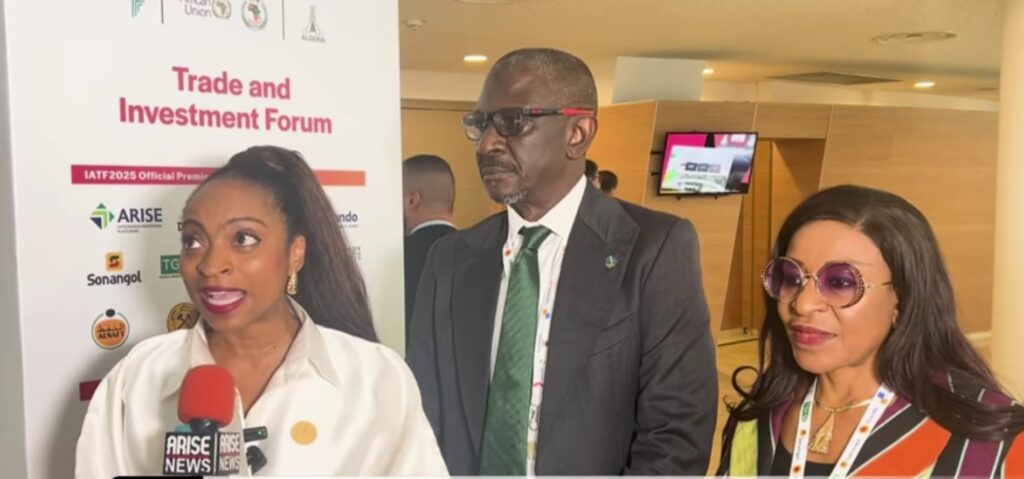
Minister of Industry, Trade and Investment, Dr. Jumoke Oduwole, MFR,Managing Director/Chief Executive of Nexim Bank, Mr. Abubakar Abba Bello and Executive Director of Nigeria Export Promotion Council (NEPC), Ms. Nonye Ayeni at the IATF 2025 in Algiers

Whereas many Nigerians are happy that at last, the Federal Government has sealed a fresh Comprehensive Economic Partnership Agreement (CEPA) signed recently in Abu Dhabi, UAE, some experts have expressed reservations on the capacity of the relevant MDAs to effectively implement and monitor the flow and effectiveness of the deal.
For several times under the current administration, the government has signed several deals including those noisy ones signed in Brazil, but up till today, nothing is being heard about their progress or level of implementation.
The two countries signed the CEPA on January 13, 2026, following negotiations led by Minister of Industry, Trade and Investment Dr. Jumoke Oduwole with support from the Federal Ministry of Justice and the Nigeria Customs Service.
Oduwole and the UAE Minister of Foreign Trade, Dr Thani bin Ahmed Al Zeyoudi, signed the agreement in the presence of the President of the Federal Republic of Nigeria, Bola Tinubu, and the President of the UAE, Sheikh Mohamed bin Zayed Al Nahyan.
The ministry described the pact as “a pragmatic and comprehensive agreement expected to deliver significant economic and strategic benefits,” including expanded trade opportunities, improved market access for exports, increased flows of high-quality investment and job creation, particularly for young Nigerians.
The Federal Government had earlier announced that Nigeria has eliminated tariffs on 6,243 products imported from the United Arab Emirates, and the UAE has removed tariffs on 7,315 products imported from Nigeria, as part of a new trade pact aimed at expanding market access for Nigerian goods, businesses, and professionals.

The Federal Ministry of Industry, Trade, and Investment disclosed this on Tuesday via a document on the Nigeria–UAE Comprehensive Economic Partnership Agreement signed in January 2026.

According to the ministry, the agreement will “expand market access opportunities for Nigerian products, businesses, and professionals into the UAE while facilitating investment flows,” marking a major step in Nigeria’s non-oil export drive and economic diversification agenda.
For trade in goods, the ministry said Nigeria has committed to eliminating tariffs on 6,243 products imported from the UAE. The UAE also committed to eliminating tariffs on 7,315 products imported from Nigeria.
Under the agreement, Nigeria will immediately remove tariffs on 3,949 products, representing 63.3 per cent of the total, while phasing out tariffs on 2,294 products over five years. Nigeria excluded 123 products from tariff liberalisation.
On its part, the UAE will immediately eliminate tariffs on 2,805 products, representing 38.3 per cent of the total, remove tariffs on 1,468 products within three years, and on 3,042 products within five years. The UAE excluded or prohibited 593 products.